













DIGGER: A Work of Genius Disguised as Beautiful Chaos
Tom Cruise, the Art of Discomfort, and a Dystopian World That Looks Disturbingly Familiar
There are films we watch, films we enjoy, and occasionally, films that seem to crawl inside our consciousness and refuse to leave.
Digger, starring Tom Cruise and directed by Alejandro G. Iñárritu, is decidedly the latter.
I loved it.
Not because it was comfortable, conventional, or particularly pleasant. Quite the opposite. This is a film that seems almost determined to irritate us, challenge us, and occasionally make us question why we are watching it in the first place.
And that, I suspect, is precisely the point.

What Iñárritu has created is something astonishingly original: a film within a play within a film, an elaborate exploration of reality, performance, environmental destruction, human vanity, and the increasingly absurd civilization we have constructed.
It is theatrical, dystopian, visually magnificent, occasionally grotesque, and intellectually exhilarating.
It is also, in my opinion, a work of genius.
The Extraordinary Beauty of Decay
Let me begin with the visual experience, because that is where Digger becomes something far more interesting than conventional cinema.
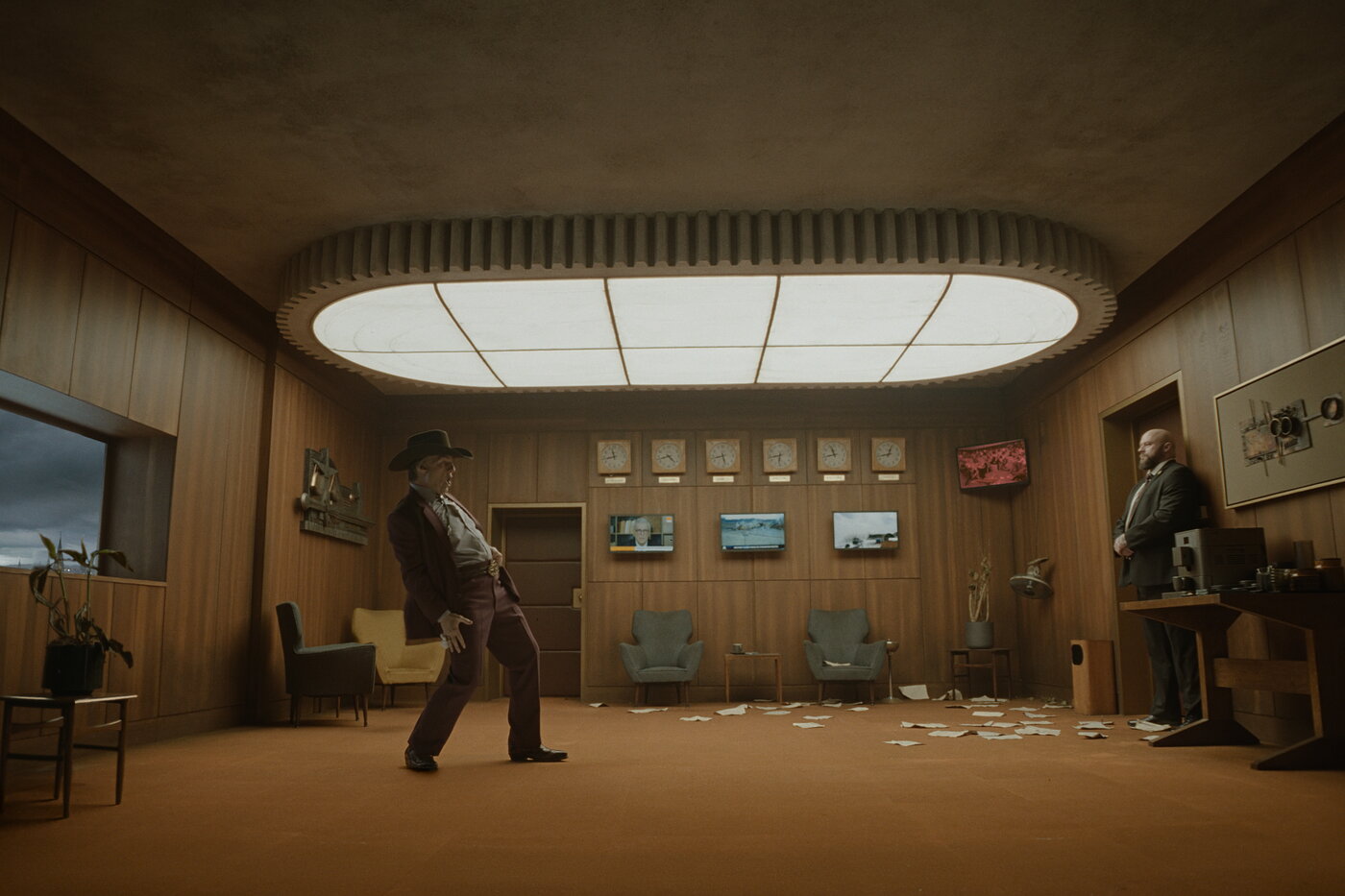
The production design is absolutely extraordinary.
The interiors are exquisite in their strangeness. There is grandeur, architectural imagination, theatrical excess, and a meticulous attention to detail that transforms practically every environment into its own artistic statement.
Yet beneath all that beauty, something is terribly wrong.
The rooms feel inhabited by a civilization that has lost its way. They are magnificent but somehow unhealthy, beautifully constructed yet spiritually depleted.
It is as though someone commissioned the world’s most talented interior designers to decorate the end of civilization.
And gave them an unlimited budget.
Consider the taxidermy room.
What an absolutely extraordinary visual statement.
Preserved animals, suspended in an artificial approximation of life, surrounded by an atmosphere that is simultaneously beautiful and disturbing.
I found it fascinating.

Is it a commentary on humanity’s obsessive desire to possess nature, control it, preserve it, and ultimately destroy it? We seem determined to collect and display the beauty of the natural world while systematically compromising the very environment that sustains it.
There is something almost perversely elegant about that contradiction.
And Iñárritu doesn’t need anyone to explain it.
The room speaks for itself.
Then there is the dripping water.
Such a seemingly insignificant detail, yet so extraordinarily effective.
The persistence of that sound. The suggestion of deterioration. The subtle psychological irritation of something that simply will not stop.
Drip. Drip. Drip.
It becomes almost hypnotic.
Are we witnessing the slow breakdown of an environment, the passage of time, or the persistent intrusion of reality into an artificial world?
Perhaps all three.
That is the beauty of intelligent filmmaking. The audience is invited to interpret rather than merely absorb.
Every element feels considered. Every visual disturbance has a purpose. Even the sounds seem designed to provoke a physical response.
This is visual storytelling at an exceptionally sophisticated level.
A Film Within a Play Within a Film
The unusual structure of Digger is central to its brilliance.
What initially appears to be one story gradually reveals itself as something else entirely, challenging our assumptions about what is real, what is performed, and what constitutes the actual narrative.
It is a film within a play within a film.
And I loved the audacity of it.
Spoilers Ahead
Tom Cruise portrays Digger Rockwell, a powerful oil magnate whose efforts to save humanity are entangled with the environmental catastrophe he helped create.
There is already delicious irony in that premise.
A man whose power and wealth are connected to the destruction of the planet now imagines himself uniquely qualified to rescue it.
Does that sound familiar?
We certainly live in an era populated by extraordinarily powerful individuals who appear convinced that their personal brilliance can solve almost any problem, including those their own ambitions may have helped create.
But Iñárritu takes this satire in a much more inventive direction.
The narrative reveals another layer of theatrical reality, with the story we thought we were watching becoming part of an elaborate performance.
Suddenly, we are confronting not simply the catastrophe itself, but the act of dramatizing catastrophe.
The performers, their constructed world, and the supposedly external reality begin to overlap.
It is an extraordinary conceptual device.
And one that raises a fascinating question:
Have we become so accustomed to performing our concern about the world’s problems that the performance has replaced meaningful action?
We attend events, make declarations, post pronouncements, celebrate awareness, and congratulate ourselves on recognizing humanity’s many crises.
Meanwhile, the water continues dripping.
The world continues deteriorating.
And the performance goes on.
When Art Imitates Life—and Then Seeps Into It
We have all heard the expression that art imitates life.
But what happens when art begins to seep into life so thoroughly that we can no longer distinguish between the two?
That, to me, is one of the most provocative aspects of Digger.
We live in a society increasingly dominated by spectacle.
Politics has become theater. Social media has become performance. Public figures construct elaborate identities, and even serious human suffering can be transformed into entertainment before our eyes.
Our lives are increasingly filtered through images, narratives, carefully curated appearances, and competing versions of reality.
Everyone seems to be performing.
Everyone has a role.
And nobody appears entirely certain where the stage ends.
Iñárritu takes this contemporary condition and exaggerates it until it becomes almost grotesque.
Yet the exaggeration is precisely what makes the film so recognizable.
There are moments when the absurdity becomes almost uncomfortable because it doesn’t seem particularly far removed from the world outside the theater.
That is the genius of effective satire.
It doesn’t simply ridicule society.
It holds up a mirror.
And sometimes the reflection is not especially flattering.
Why Does Nobody Look Healthy?
One of the most striking aspects of the film is the physical appearance of its characters.
Nobody seems particularly healthy.
Nobody looks especially glamorous.
Even Tom Cruise, a man who has seemingly spent decades defying age, gravity, and the ordinary limitations of the human body, abandons the polished Hollywood hero we have come to expect.
There is little conventional beauty here.
The characters often appear exhausted, disheveled, unwell, or strangely disconnected from any recognizable sense of vitality.
And I found that fascinating.
We live in a culture obsessed with wellness, beauty, longevity, physical perfection, and the endless pursuit of youth.
We have entire industries promising to optimize every conceivable aspect of human existence.
Yet here is a fictional world filled with wealth, privilege, technological sophistication, and elaborate surroundings in which almost nobody seems genuinely well.
Is this the dystopian future?
Or are we already beginning to inhabit it?
Perhaps the ultimate irony is that a civilization can acquire enormous material wealth while simultaneously losing the things that make life worth living.
Beauty without joy.
Luxury without comfort.
Power without wisdom.
And an extraordinary amount of noise without much meaningful communication.
The contrast is devastating.
The Art of Making Us Uncomfortable
Digger is deliberately grating—visually, audibly, and through performances that border on the absurd. At times, the experience is almost physically irritating. And that is precisely the point.
While Hollywood generally aims to please, Iñárritu seems spectacularly uninterested in making audiences comfortable. Instead, he demands that we observe, interpret, and embrace ambiguity.
The oppressive imagery, intrusive sounds, and exaggerated performances continually disrupt our expectations. Just when we think we understand the film, the rules change.
Brilliant.
This is not careless cinematic chaos. It is meticulously orchestrated artistic provocation, where magnificent set design, unsettling imagery, and abrasive sound become part of a larger statement.
The discomfort is not a flaw in the experience. It is the experience.
Tom Cruise Without the Hollywood Illusion
Cruise deserves considerable credit for embracing a role that so dramatically challenges his established screen persona.
We know him as the polished, athletic, endlessly resourceful hero capable of outrunning explosions, piloting aircraft, and saving civilization through sheer determination.
Here, the familiar heroic image becomes something much stranger.
The performance is exaggerated, audacious, occasionally ridiculous, and entirely committed to the film’s unconventional universe.
Rather than asking us to admire him, Cruise seems willing to make himself part of the artistic provocation.
That takes confidence.
It also takes an actor who understands that there is considerably more to cinema than being attractive and likable.
The most interesting performances are not always the most flattering ones.
Sometimes an actor’s greatest achievement is allowing the audience to see something deeply uncomfortable.
And Cruise does exactly that.
A Social Statement Masquerading as Surrealism
Beneath the theatrical madness, Digger is making an unmistakable social statement.
About the environment.
About unchecked ambition.
About wealth and power.
About our strange relationship with nature.
And perhaps most importantly, about the increasing distance between what humanity claims to value and how it actually behaves.
The taxidermy room alone could inspire an entire philosophical discussion.
The dripping water could become an installation in a contemporary art museum.
The peculiar, deteriorating interiors might just as easily belong in a major exhibition examining the collapse of modern civilization.
This is what makes the film so exceptional.
It operates simultaneously as cinema, theater, visual art, and social criticism.
The imagery is not merely illustrating the dialogue.
Quite often, it is doing the intellectual heavy lifting.
I found myself studying the environments, noticing the textures, listening to the sounds, and thinking about the relationships between objects and people.
These are the pleasures of experiencing a genuine work of art.
Not simply following a plot, but discovering meaning in the choices an artist makes.
And Iñárritu makes some spectacular choices.
Genius Isn’t Always Pretty
Will everyone love Digger? Certainly not. Some will find it exhausting, pretentious, or deliberately obscure. But great art isn’t obligated to please everyone.
Its beauty is unconventional, its humor dark, and its visual imagination extraordinary. From the haunting taxidermy room to the relentless dripping water, every detail contributes to an experience that is as intellectually provocative as it is visually magnificent.
Actually, the deliberate ugliness contrasted with exquisite design, and the film’s ability to communicate more through imagery than dialogue. This is cinema elevated to art.
The Final Frame
Perhaps the greatest tragedy of Digger is its final irony: the characters perform a play about a catastrophe that has already occurred. They are reenacting the destruction of a world they continue to inhabit, unable to escape its consequences.
It is a devastating artistic statement. The tragedy has become theater, yet the reality remains.
The absurdity feels strangely familiar. The beautiful decay, disturbingly recognizable.
For me, Digger is a remarkable achievement—audacious, visually breathtaking, intellectually provocative, and gloriously unconventional.
It challenges us to consider whether our society has become so consumed with spectacle that we are merely performing our concern while the world deteriorates around us.
Art imitates life. But in Digger, the distinction disappears. Humanity has transformed its own tragedy into entertainment, even as it continues to live with the consequences.
And that is when cinema transcends entertainment and becomes genius.
Susan Short is the publisher of Family Beautiful Magazine & Media, covering arts, entertainment, culture, and the creative forces shaping contemporary life.